
The Oxygen & Acid Equation
By James Baxendale on 11 June 2026
The relationship between your cardiovascular ceiling and the deep burn of intense effort is one of the most misunderstood dynamics in endurance sports. If you’ve ever felt your thighs turn to lead during a brutal uphill climb, or watched your breathing completely redline as you struggled to hold a blistering pace, you’ve operated right at the intersection of VO2 Max and lactic acid. For decades, locker-room wisdom has painted lactic acid as a toxic waste product responsible for your tomorrow-morning stiffness, while treating VO2 Max as a rigid genetic ceiling. In reality, the science reveals a beautifully fluid partnership between the two, driven by evolutionary survival and metabolic adaptation.
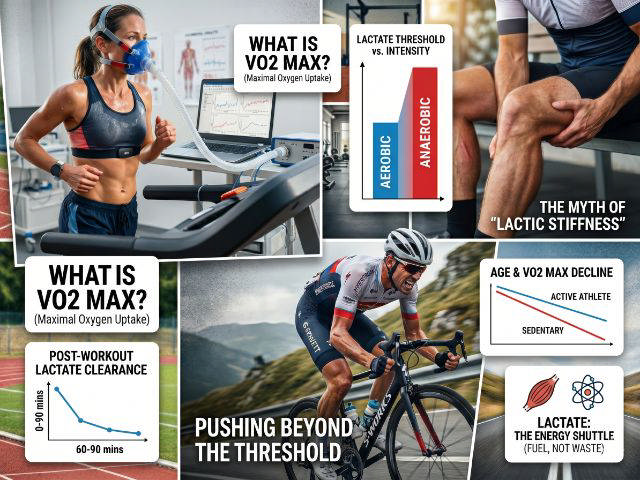
To understand how they connect, it helps to picture your VO2 Max as the absolute size of your aerobic engine, it represents the maximum volume of oxygen your body can transport and utilize during peak exertion. When you push your pace beyond a certain threshold, that aerobic engine can no longer process energy fast enough to meet the demand. To keep you moving, your body triggers its backup generator, transitioning into its anaerobic system. This precise cross-over point is your lactate threshold. As you push past it, your body breaks down carbohydrates for fuel without sufficient oxygen, creating a byproduct that immediately splits into lactate and hydrogen ions.
A massive misconception centres on this exact moment. Lactate itself isn't a villain; it is actually a highly efficient fuel source that your heart, liver, and non-working muscles desperately scramble to recycle. The real culprit behind that localized, white-hot muscular burn is the accumulation of those hydrogen ions, which cause the pH levels in your tissue to drop. A higher VO2 Max essentially widens your primary energy highway, allowing you to sustain much higher power outputs before your body is forced to rely on this burning, anaerobic backup system.
How quickly you reach this tipping point is influenced by a mix of genetics, fibre typing, and age. Athletes blessed with an abundance of endurance-oriented, mitochondrial-dense slow-twitch muscle fibres naturally process waste efficiently and can cruise at high speeds without accumulating much acidity. Conversely, those with a higher percentage of fast-twitch fibres rely heavily on anaerobic pathways, producing hydrogen ions much faster.
Age enters the equation through the heart. As the decades pass, our maximum heart rate naturally declines due to changes in the heart’s electrical conduction system. Because the heart cannot beat quite as fast as it used to, the maximum volume of oxygen-rich blood pumped per minute decreases, dragging VO2 Max down with it. While a sedentary lifestyle causes this ceiling to drop by roughly ten percent every decade after thirty, seasoned endurance athletes can cut that rate of decline completely in half. For master's athletes who have never truly optimized their training, dedicated high-intensity interval work can actually increase absolute VO2 Max, effectively outrunning the biological clock.
When it comes to managing the aftermath of a hard effort, common recovery practices like static pre-training or post-training stretching actually do nothing to reduce or clear this acidity. Lactate is cleared strictly through metabolic processing and blood flow, not by physically elongating the muscle tissue. Similarly, the crippling stiffness you feel a day or two after a workout has nothing to do with acid. Blood lactate levels return to completely normal resting baselines within an hour or two of crossing the finish line. That delayed soreness is actually the result of microscopic muscle tears and the subsequent cellular remodelling required to build back stronger.
Furthermore, this process doesn't trigger systemic chronic inflammation. Modern sports science now views lactate as an essential signalling molecule that helps initiate the body's acute, localized healing response, prompting your cells to adapt to the stress of training.
Rather than relying on passive stretching, the most effective ways to delay the burn and speed up recovery involve active physiological manipulation. Executing a low-intensity active recovery flush right after a hard block keeps your heart rate gently elevated, maintaining the high blood flow necessary to quickly shuttle waste out of the working muscles. Athletes also use targeted supplementation, such as beta-alanine, to increase intramuscular carnosine levels, which acts as a natural buffer against those burning hydrogen ions. On an elite level, some even utilize sodium bicarbonate protocols to temporarily increase blood alkalinity, creating a pressure gradient that draws acidity out of the muscle cells faster.
Nutrition plays an equally powerful role in dictating how your engine runs. Because your body generates lactate by metabolizing carbohydrates, a diet rich in clean carbohydrates provides the essential fuel required for top-end, high-intensity anaerobic power. A chronic low-carbohydrate or ketogenic approach drastically limits your ability to hit those higher zones because the body lacks the glycogen necessary to sustain high-lactate work. To optimize your body's natural buffering capabilities, sports nutritionists emphasize a strategy rich in nitrates and antioxidants, structured around a targeted fuelling schedule:
| Meal | Food Items | Purpose |
| Pre-Workout (2 hours before) | Oatmeal topped with sliced banana, a drizzle of honey, and a glass of concentrated beetroot juice. | High-quality carbohydrates to top up liver and muscle glycogen; nitrates to optimize oxygen efficiency and blood flow. |
| Intra-Workout | Carbohydrate-electrolyte drink containing glucose/fructose blend (aiming for 60-90g of carbs per hour for heavy sessions). | Maintains blood glucose levels, sparing muscle glycogen and reducing early anaerobic stress. |
| Post-Workout Recovery | Smoothie with whey or plant protein, frozen blueberries, spinach, half an avocado, and tart cherry juice. | Protein initiates muscle tear repair; tart cherry and spinach deliver potent antioxidants to support the natural inflammatory response. |
| Lunch | Grilled wild salmon, wild rice, and a massive side of sautéed kale and broccoli sprouts drizzled with olive oil. | Omega-3 fatty acids reduce cellular stress; dark leafy greens support overall systemic health and vascular function. |
| Dinner | Lean chicken breast or tofu, sweet potato mash, and a large mixed salad featuring arugula, grated raw beets, and pumpkin seeds. | Complex carbs to restock glycogen for tomorrow; additional nitrates from arugula and raw beets to aid recovery. |
While the fundamental architecture of this fuelling strategy remains constant across a lifespan, the scaling changes with age. Master's athletes generally require a slightly lower volume of total carbohydrates to match a shifting metabolic rate, but they require a much higher focus on clean, high-quality protein distribution to stimulate muscle repair, alongside an increased emphasis on anti-inflammatory fats to counter a naturally slower recovery cycle.
Ultimately, endurance performance comes down to a harmonious balance between two distinct systems. VO2 Max represents your absolute aerobic ceiling, the maximum capacity of your cardiovascular system to deliver and utilize oxygen. Lactic acid, on the other hand, is your body's vital survival mechanism and energy shuttle, stepping in to provide rapid fuel when your physical demands outpace your oxygen intake. By training to raise your VO2 Max, you widen the gateway of oxygen, and by utilizing smart recovery and targeted nutrition, you master the acid, turning a supposed limitation into your greatest athletic asset.