
How to ride your favourite outdoor routes from your living room
By James Baxendale on 17 June 2026
When the winter chill sets in and daylight shrinks, keeping up your cycling momentum can feel like an uphill battle. But staying indoors doesn’t have to mean staring at a blank wall or grinding away mindlessly on an old-school stationary trainer.
Think of modern virtual cycling simulators as a portal. Instead of just passing the time, you can ride your favourite local loops, tackle exact racecourses before event day, and jump into a global peloton without leaving the house. If you are new to the indoor world, getting everything set up can seem like a lot to take in, but breaking it down makes it simple.
So, how does riding your own routes actually work? Can a simulator really replicate the physical demands of your real-world weekend ride? Yes, completely. You take a standard GPS file like a .gpx or .fit file exported from Strava or Garmin Connect, and upload it into your simulator software. The program reads the precise coordinate and elevation data of that route.
When you ride it inside, your smart trainer automatically adjusts its resistance to match the actual hills and flats of that road. If the virtual road tilts upward into a steep climb, your legs will feel it immediately. For event preparation, this is a massive advantage because you can pre-ride the exact gradients of an upcoming race, figuring out your pacing, gearing, and energy expenditure weeks before you even arrive at the start line.
And what about the gear? Well setting up your training space requires a mix of physical hardware and a bit of software.
On the hardware side, everything revolves around a smart trainer. If you want a budget-friendly entry point, a wheel-on trainer like a Wahoo Kickr Snap keeps your bike fully intact while your rear tire presses against a roller. If you want a smoother, quieter experience that replicates steep climbs more accurately, you want a direct-drive trainer like a Wahoo Kickr Core or a Magene T200. With these, you remove your rear wheel entirely and mount your bike's chain directly onto the trainer. You can easily source these locally from major South African cycling shops like Solomons Cycles, Evobikes, West Rand Cycles, or Olympic Cycles.
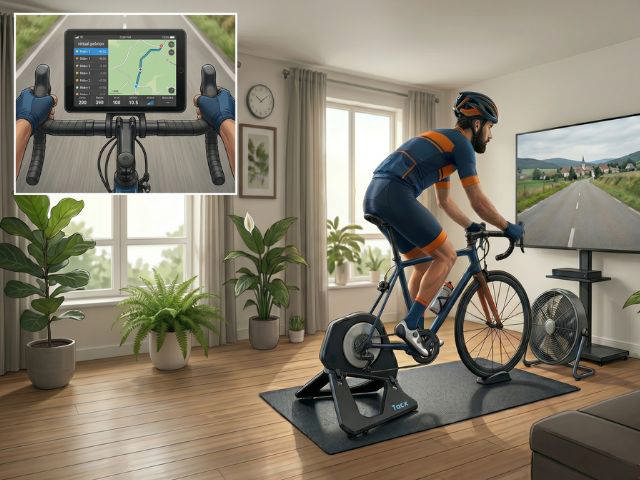
Beyond the trainer, you will need a heavy-duty floor mat to catch sweat and deaden vibrations, along with a high-powered fan or two. Without a natural headwind, your core temperature rises rapidly indoors, meaning you will heat up and sweat significantly more than you do outside. For the visual side, you just need a screen like a smartphone, tablet, a laptop, or a dedicated setup connecting your device to a large TV via an HDMI cable or an Apple TV. Pop in a pair of sweat-resistant wireless headphones, and you are ready to connect via Bluetooth or ANT+.
Once your bike is on the trainer, you need a digital platform to bring it to life. These software options generally run on cloud-based subscriptions, which cost roughly R280 to R360 a month. The nice thing here is flexibility; you can pay for the subscription during the dark winter months and simply pause it when spring arrives and you head back outdoors.
If your primary goal is to see real-world scenery, train on exact racecourses, or upload your own GPX files, platforms like Rouvy or FulGaz are your best bet. They overlay your virtual avatar onto high-definition video footage or Google Street View imagery of real roads.
If you prefer a highly social, interactive environment, Zwift is the absolute king. It drops you into massive 3D virtual worlds where you can join scheduled group rides and jump into virtual pelotons with thousands of other riders in real time. Zwift even simulates "virtual drafting," meaning the software actually reduces the resistance on your trainer when you tail closely behind another rider's avatar, letting you work together just like a real pack.
In terms of the upfront investment for the trainer itself, an entry-level wheel-on smart trainer will generally cost you around R6,000 to R8,000. If you decide to step up to a highly accurate, whisper-quiet direct-drive trainer, you can expect the cost to range anywhere from R9,500 to R20,000+ depending on the specific model and features.
There are huge benefits to training indoors…
While avoiding freezing early mornings and traffic is a clear win, training in your living room offers a few unexpected performance benefits.
First, a one-hour indoor session is incredibly time-efficient because there are no traffic lights, stop signs, or downhills to coast down, you are pedalling 100% of the time.
Second, that extra heat you generate indoors can actually be used to your benefit. Training in a warmer, controlled indoor environment acts as an excellent tool for heat acclimation. It triggers positive cardiovascular adaptations, like increasing your blood plasma volume, which boosts your overall efficiency and pays massive dividends when you head back out into warmer weather later in the year.
Don't let the winter season stall your progress. With the right trainer, a solid fan, and a virtual route mapped out, you can turn your indoor space into the ultimate testing ground for your cycling goals.