

Getting Faster While You Rest
By James Baxendale on 17 July 2026
As endurance athletes, it is easy to get caught up in the grind and measuring our success by the amount of sweat on the trail or the wattage we put out on the bike. But physiologically speaking, you don't actually get fitter during a workout. You get fitter while you rest.
It is all down to a process called supercompensation. When you train, you are breaking down your body. Supercompensation is the physiological response where your body rebuilds itself slightly stronger than its previous baseline to handle that stress better next time. The trick, of course, is finding the perfect balance between breaking it down and building it back up.
Finding the Sweet Spot: The "Perfect" Amount of Effort
How hard should you push to trigger those gains without digging a hole you can't climb out of? Sports scientists look at something called the Acute-to-Chronic Workload Ratio (ACWR). It is a way of comparing what you've done over the past 7 days against what your body is used to handling over the past month.
To maximize your fitness gains while keeping injury at bay, you want that ratio sitting between 0.8 and 1.3. In simple terms: do not bump up your weekly workload by more than 30% of your recent historical average. Pushing past a 1.5 ratio means you are tossing your tissues into the deep end before they know how to swim.
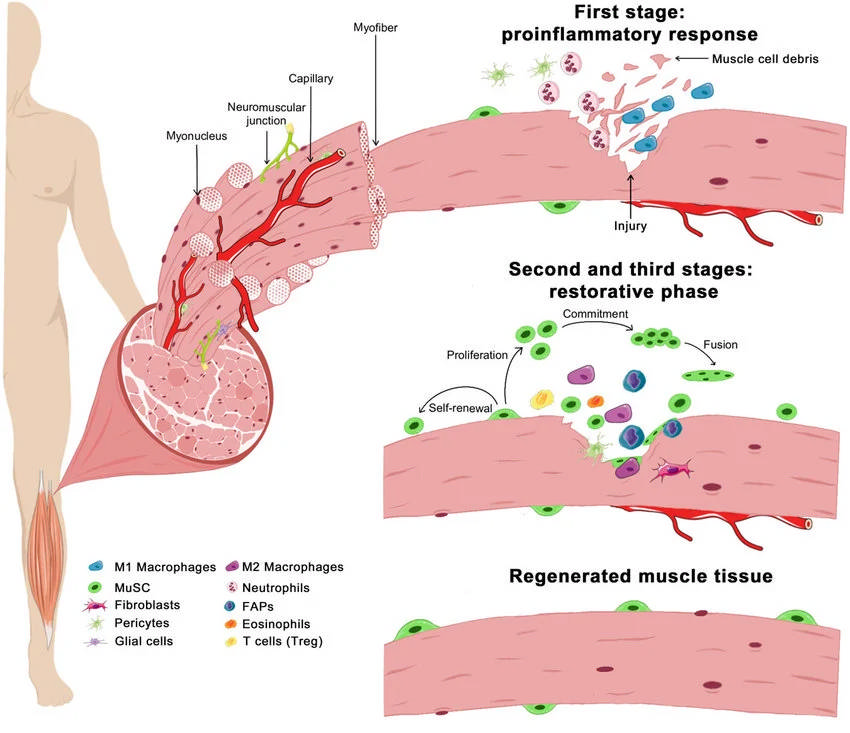
Stages of skeletal muscle fibre repair. Source: ResearchGate
The Reality Check: A heavily taxed muscle group usually needs a full 24 to 72 hours to repair micro-tears and enter the supercompensation phase.
Can You Still Train on Sore Muscles?
The short answer is yes… If we are talking about standard DOMS (Delayed Onset Muscle Soreness). Light, active recovery, like a Zone 1 spin or a very easy jog, is actually great for you. It gets the blood flowing and helps clear out metabolic waste without causing further structural damage.
But, if your legs feel like lead and you try to force an intense interval session, you are interrupting that crucial restorative phase. You delay the very supercompensation you are chasing and crank up your injury risk.
Age and the Recovery Timeline
Let's talk about the elephant in the room: aging. Once you cross into your 30s, and certainly beyond, your body's natural repair mechanisms start to slow down. We see natural declines in testosterone and human growth hormone (HGH), and cellular turnover just isn't as snappy as it used to be.
Plus, tendons and ligaments start to lose some of their elasticity. This means you need more deliberate warm-ups and longer recovery windows. That heavy training block that took you 24 hours to bounce back from at 22? That same block might take 48 to 72 hours to recover from when you are 42. Diet is your best weapon for bridging that age gap, but when you eat might be just as important as what you eat.
Fuelling the Rebuild: The "Anabolic Window" Truth
For years, gym lore preached the 30-minute "anabolic window"—the idea that you had to slam a protein shake the second you finished a workout or your effort was wasted. Modern sports science has untangled this, and for endurance athletes, we need to separate how our bodies handle protein versus how they handle carbohydrates.
Protein: The "Barn Door" Effect
For muscle repair, the anabolic window isn't a tiny porthole; it is more like a massive barn door that stays open for a long time. After a hard endurance effort, your muscle protein synthesis remains elevated for 24 to 48 hours. As long as you are hitting your total daily protein requirements through your regular meals, your muscles will have the amino acids they need to rebuild. Chugging a protein shake in the locker room won't miraculously increase your gains compared to eating a solid meal two hours later.
Carbohydrates: Where Timing Actually Matters
When you finish a gruelling run or ride, your muscle glycogen (your stored carbohydrates) is depleted. Immediately post-exercise, your muscle cells are highly sensitive to insulin, and an enzyme called glycogen synthase is hyperactive.
If you consume carbohydrates within the first 30 to 60 minutes, you can replenish glycogen stores almost twice as fast as you would if you waited two hours.
The Golden Ratio (3:1)
To maximize this carbohydrate window, sports dietitians recommend a 3:1 or 4:1 ratio of carbohydrates to protein. Adding a little bit of protein to those carbohydrates actually spikes your insulin response slightly higher, which helps drive that glucose into the muscles even faster than carbs alone.
This is exactly why chocolate milk became the holy grail of cheap recovery drinks for runners and cyclists, because it naturally hits that 3:1 ratio almost perfectly.
- When you need to rush: If you are doing "two-a-days" or back-to-back high-intensity days, you have less than 24 hours to refill your tank. You must hit that 30-minute window.
- When you can relax: If you have 24 hours or more before your next hard effort, your body has plenty of time to replenish its glycogen stores through normal daily meals. Take your time, shower, and eat when you get hungry.
Sleep & Supplements
Forget the supplement aisle for a second; nothing out-performs sleep. It is during your deep sleep phases (Non-REM Stage 3) that your pituitary gland releases the vast majority of your daily Human Growth Hormone. If you aren't getting 7-9 hours of quality sleep, your entire recovery timeline is compromised.
If your sleep and diet are dialled in, a few evidence-based natural additions can help speed things up:
- Tart Cherry Juice: Packed with anthocyanins, proven to reduce inflammation and speed up recovery from DOMS.
- Magnesium: Great for regulating muscle contractions, preventing cramps, and helping your central nervous system relax.
- Omega-3 Fatty Acids: Excellent for reducing exercise-induced joint inflammation.
- Curcumin (Turmeric): A powerful natural anti-inflammatory that helps manage joint pain without the gut risks associated with NSAIDs (like ibuprofen), which can actually stunt your muscle growth if overused.
Comparing the Distance: 5km vs. Marathon
Finally, the distance you are training for completely changes your recovery needs.
If you are training for a fast 5km, your workouts are shorter but much sharper. This places a massive amount of stress on your central nervous system. You generally need 24 to 48 hours to recover between hard, high-intensity sessions, prioritizing rapid glycogen replenishment to get ready for the next interval set. After a 5km race, you typically only need 3 to 7 days of rest before resuming hard efforts.
Marathon training is a different beast entirely. The sheer volume places a massive muscular and metabolic toll on your body. When you finish a massive weekend long run, your body often needs 48 to 72 hours just to clear the fatigue and begin structural repair. Your focus shifts from just carbs to prioritizing protein for structural repair and fats for a hormonal reset. And after crossing the finish line of a full 42.2km? You are looking at a solid 2 to 4 weeks of active recovery and base building before your body is ready to handle hard, structured training again.
The Takeaway: Treat Recovery as Your Next Workout
If there is one thing to pull from all this science, it is that recovery isn't just the absence of training—it is an active, essential part of getting faster and stronger. You cannot out-train chronic fatigue, and you certainly cannot out-supplement a lack of sleep.
To apply this to your own block of training this week, keep these three pillars in mind:
- Listen to the Math: Keep your weekly workload increases under 30% to stay in that safe supercompensation zone. Don't throw your body into the deep end and expect it not to panic.
- Nail the Basics First: Before you stress about perfectly timing a 3:1 chocolate milk ratio or buying expensive tart cherry juice, ask yourself the hard questions: Am I getting 7 to 9 hours of quality sleep? Am I eating enough total daily protein? Build the foundation before you worry about the paint.
- Context is Everything: Match your fuelling and rest to your specific effort. If you are going for an easy recovery jog tomorrow, a normal dinner is perfectly fine. But if you are doing back-to-back high-intensity intervals, you need to hit that 30-minute carbohydrate window to ensure your tank is full for round two.
Next time you unlace your shoes or unclip from the pedals, try shifting your mindset. That moment isn't the end of your current workout; it is the very first step in preparing for your next one. Train smart, recover harder, and let the gains come to you.