
Super Shoe Training: Mechanics, Loading, Strategy
By James Baxendale on 24 July 2026
We’ve all seen the finish lines lately where carbon-plated shoes are shattering PBs across the board. But chat with any sports physio, and you'll hear about a parallel trend: a sudden spike in weird, stubborn lower-limb niggles.
The culprit? Runners treating these race-day rockets like daily drivers.
Let's break down exactly what happens when you lace up "super shoes," why your calves might be complaining, and how to build a strategic shoe rotation that protects your legs while still maximizing your speed on race day.
The Super Shoe Trifecta: First off, it’s not just the carbon plate doing the work. The magic of a super shoe lies in a specific trifecta: a rigid plate acting as a lever, high-stack PEBA foam acting like a trampoline, and an aggressive rocker geometry rolling you forward.
Look at the pioneers, the Nike Alphafly and Vaporfly. They pair ultra-soft ZoomX foam with a rigid plate that heavily relies on an aggressive forefoot strike. The ASICS Metaspeed series (Sky and Edge) takes a slightly different approach, tweaking plate placement to cater specifically to stride-lengtheners versus cadence-increasers. Then you have the Saucony Endorphin Pro, which features an aggressive "SpeedRoll" geometry that practically forces a fast transition.
Every single one of these shoes dictates a mechanical path for your foot. They don't just cushion your run; they change how your body absorbs the miles.
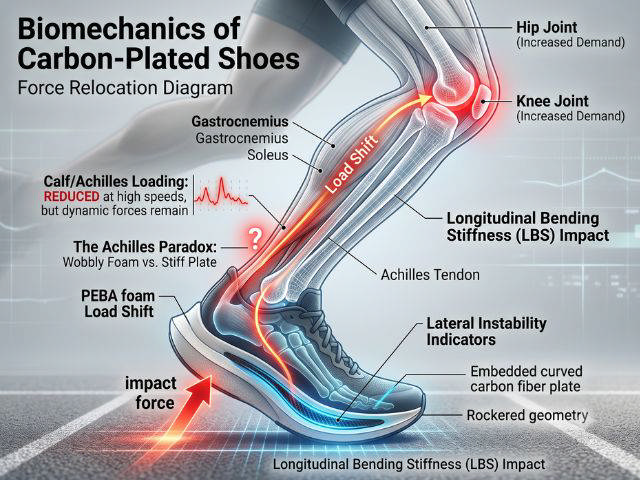
The Science of Shifting the Load: So, what is actually happening to your legs? It’s vital to understand that super shoes don't magically eliminate impact force; they just relocate it.
Studies consistently show that a stiff carbon plate reduces the workload at your metatarsophalangeal joint (the big toe) and the ankle. Generally speaking, this shifts the heavy lifting away from your calf complex and up into your knees and hips.
However, this creates what we can call the Achilles Paradox.
While your overall calf workload drops when you're running fast, the hyper-squishy foam introduces a massive amount of lateral instability. Every time your foot strikes the ground, your ankle stabilizers have to work overtime just to keep you from wobbling. Musculoskeletal modelling shows that if your mechanics aren't perfectly dialled in, the sheer stiffness of the shoe can actually increase peak Achilles tendon force.
Experienced runners naturally harness the plate efficiently. But if you lack proximal strength in your hips and core, you'll likely compensate for the extreme stiffness by altering your leg extension, thereby inadvertently torquing the Achilles.
The Golden Rule: When to Train vs. When to Save
Carbon plates absolutely hate slow paces. When you're jogging easy, your stride timing misaligns with the shoe's rocker. Instead of a smooth, propulsive roll, the plate acts like a rigid plank, forcing your lower leg into a wrestling match with your footwear.
When to Save Them: Keep the carbon in the closet for easy runs, recovery days, and your Zone 2 base building. For the daily grind, stick to traditional, flexible trainers. Running in standard shoes maintains your intrinsic foot strength and preserves your natural ankle mobility.
When to Wear Them: Lace them up for race-pace intervals, tempo runs, and key long runs. You do need to train in your super shoes enough so that your tissues adapt to their specific loading patterns and the increased hip and knee demands. You never want race day to be a biomechanical shock to the system.
The Bottom Line
Carbon-plated shoes are incredible performance multipliers, but they are not shortcuts. If your biomechanical foundation has cracks, the shoe will only amplify them.
Audit your shoe rotation this week. Make sure you have a flexible daily trainer for the bulk of your mileage, prioritize heavy, slow resistance calf raises in the gym, and treat your super shoes like the finely tuned tools they are.