
The Rhythm of the Run: Tarmac vs. Trail
By James Baxendale on 24 July 2026
If you've spent any time logging miles on the road, you’ve probably had the "180 steps per minute" rule drilled into your head. Road runners love data, and hitting that golden cadence number is often seen as the secret to running faster and injury-free.
But what happens when you take that perfectly tuned road stride and throw it at the rocky, root-mangled slopes of Table Mountain or the Drakensberg?
The short answer: the math completely changes. Let's look at what professional coaches and top South African trail athletes have to say about optimizing your running economy, whether you are pounding flat tarmac or scrambling up a technical trail.
The Road Runner's Equation: Rhythm and Routine: On flat tar, running speed is a simple, mathematical equation
Speed = Stride Length x Cadence.
On the road, the surface never changes. This predictability allows you to lock into a structured, cyclic movement and direct all your energy forward.
- The Overstriding Trap: Professional coaches and physical therapists note that recreational runners often default to a long stride and a low cadence. This causes your foot to land way out in front of your centre of mass, essentially hitting the brakes with every step.
- The 5% Fix: Exercise physiologists and coaches recommend increasing your cadence by just 5-10%. Doing this naturally shortens your stride length, significantly reducing the impact forces on your knees, hips, and heels.
When road running, finding your optimal cadence (which varies based on your height and pace, usually between 160-180 SPM) and holding it steady is the ultimate display of running economy.
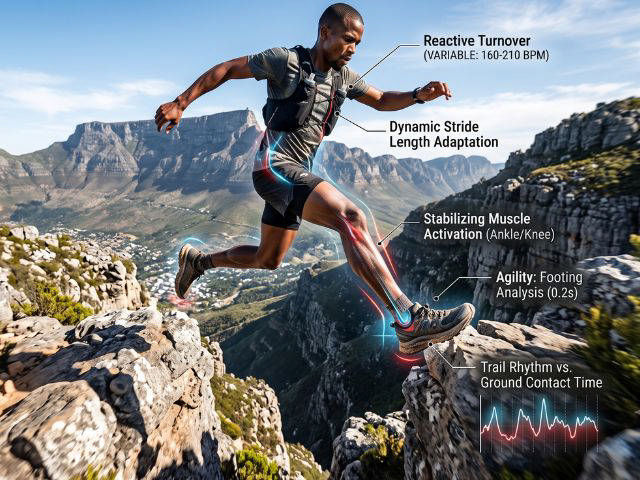
The Trail Runner’s Reality on the other hand, is vastly different. Take that rigid 180 SPM metronome onto a technical South African trail, and you will likely end up face-first in the fynbos.
As South African ultrarunning legend Ryan Sandes notes regarding his training and racing philosophy, trail running is largely about adapting to "the unknown and adventure". The terrain dictates your rhythm, not your watch.
Trail runners have to abandon the idea of a fixed cadence. Instead, they rely on proprioception, which is the body's subconscious ability to sense its position and adjust to uneven ground. SA trail champion Megan Mackenzie highlights that her favourite training grounds involve "'scrambly' routes on Table Mountain," which demand a highly reactive approach to movement rather than a repetitive stride.
Here is how top athletes manipulate their stride on the dirt:
- The Technical Climb: When hitting a steep, rocky ascent, your stride length must drastically shorten. You aren't trying to maintain a high cadence; instead, you are taking powerful, deliberate steps. Elite athletes often increase their arm swing on climbs, which creates a cascading effect that naturally quickens foot turnover without overextending the legs.
- The Technical Descent: This is where cadence spikes. Rather than taking long, bounding strides downhill (which shreds your quads and risks a rolled ankle), pros use incredibly rapid, short, "pitter-patter" steps. Some athletes report their cadence hitting over 200 SPM on technical, rocky descents just to maintain balance and braking control.
If you are a road runner transitioning to the trails (or a trail runner looking to get faster on the flats), here is the actionable advice:
Ultimately, road running is about consistency, while trail running is about adaptability. Master both, and you'll build the ultimate, bulletproof running economy.