
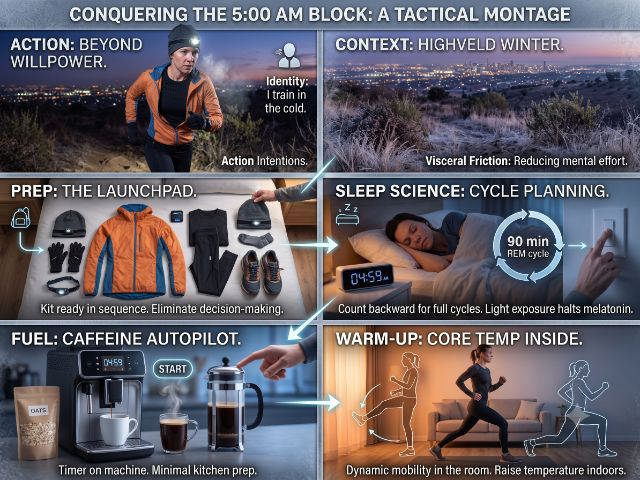
Conquering the 5AM Block
By James Baxendale on 07 August 2026
Mastering the early morning start across Gauteng and the Free State isn’t about raw willpower, it is about behavioural psychology, biological timing, and strategic preparation. When the temperature drops, getting out the door is often harder than the workout itself.
Here is how to hack your winter motivation, beat the mental block, and keep your training on track through the darkest, coldest mornings of the year.
The Psychology of the Alarm Clock
When your alarm rings in the dark, your brain immediately calculates the "cost" of the action. Behavioural psychologists refer to this as visceral friction. The higher the perceived friction (finding clothes, facing the cold, making breakfast), the more likely your brain will flood your system with rationalizations to hit snooze.
To beat this, you need to rely on Implementation Intentions, which is about pre-deciding your actions so that when the alarm goes off, no decision-making is required. Motivation is a feeling; discipline is a system.
"I am a runner, and runners train in the cold." By shifting your mindset from a goal (like running 10km) to an identity, you align your actions with who you believe you are, making the discomfort a badge of honour rather than a daily negotiation.
Architecting the Night Before
You do not wake up motivated; you wake up to the environment you designed the night before. Reducing friction is your greatest weapon against the 5:00 AM block.
- The Launchpad: Lay your entire kit out in the exact sequence you will put it on. Socks by the shoes, base layer over the tights. Some athletes even sleep in their clean base layers to eliminate the shock of cold fabric in the morning.
- Fuel and Caffeine on Autopilot: Set your coffee maker on a timer, or prep your French press the night before so all you have to do is hit the kettle. Take it a step further by having your overnight oats or morning protein shake already mixed in the fridge. Eliminating kitchen prep saves precious minutes and mental energy.
- The Warm-Up Starts Inside: Do a dynamic mobility routine (lunges, leg swings, arm circles) in your living room before stepping outside. Raising your core body temperature indoors makes the biting Highveld wind feel significantly less intimidating.
Sleep Science: Setting the Internal Clock
You cannot cheat sleep, especially in winter when your circadian rhythm naturally wants to sync with the later sunrise.
- Count Backwards: If you need to be up by 5:00 AM, your wind-down routine must begin by 8:30 PM. Aim for 7.5 to 8 hours of sleep. Waking up in the middle of a deep sleep cycle causes sleep inertia (that groggy, heavy feeling). Use a sleep calculator to aim your alarm for the end of a 90-minute REM cycle.
- Light Exposure: Melatonin makes you sleepy, and darkness triggers it. The moment your alarm goes off, turn on the brightest lights in your room. This immediate light exposure halts melatonin production and signals to your brain that it is time to perform.
The Armor: Layering for the Highveld
There is no bad weather, only bad gear. The secret to winter running is managing moisture. You want to start your run feeling slightly cold; if you are warm standing still at the gate, you are going to overheat by kilometre three.
- The Base Layer: You need a synthetic or merino wool base to wick sweat away from your skin. Avoid cotton at all costs because once it gets wet from sweat, the cold air will turn it into an icebox. First Ascent offers excellent thermal base layers tailored for South African conditions.
- The Mid-Layer (Optional): For those sub-zero Free State mornings, a quarter-zip fleece provides insulation while still allowing for breathability.
- The Shell: A lightweight, windproof jacket is crucial to block the wind. Look for packable options from K-Way or Salomon that you can quickly stash into your hydration belt once the sun comes up.
- Extremities: You lose significant heat through your head and hands. Invest in a moisture-wicking beanie, lightweight running gloves, and performance gear. High-quality running caps and socks from local brands like Versus or Falke will keep you insulated without causing friction.
Embrace the Discomfort
The first ten minutes are always a lie. Your body will protest, your lungs will feel the bite of the cold air, and your mind will suggest turning back. Push through to minute eleven. By then, the endorphins kick in, the rhythm takes over, and you realize exactly why you do this.