
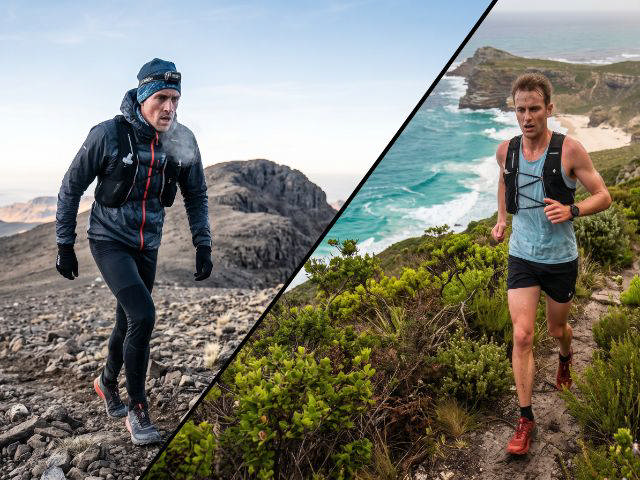
High Altitude vs. Coastal Racing: Mastering the Elevation Shift
By James Baxendale on 15 August 2026
South Africa’s trail calendar forces athletes to be adaptable. One month you are scrambling up the oxygen-depleted ridgelines of the Witteberg at the SkyRun, and the next, you are grinding through the humid coastal forests of the Otter Trail.
But swapping the thin, dry air of the Highveld for the thick, humid air of the coast, or vice versa, triggers massive physiological shifts. Understanding the science behind these environments is the difference between a podium finish and a mid-race blowout.
The Highveld Advantage (And Its Hidden Trap) | Johannesburg sits at roughly 1,750 meters above sea level. Training here naturally increases red blood cell production, enhancing the body’s ability to transport oxygen. When Highveld runners descend to coastal races like the Ultra-Trail Cape Town (UTCT), they experience what feels like natural doping. The air is dense, breathing feels effortless, and heart rates stay lower at faster paces.
However, this physiological advantage comes with a dangerous trap:
the pacing delusion.
Because running feels so easy in the first 10 kilometres, Highveld athletes routinely go out too fast. By the time they hit the first major coastal climb, the second hidden variable strikes… humidity. The coast restricts the body’s ability to cool itself through sweat evaporation. When a Highveld runner redlines their pace in high humidity, their core temperature spikes, leading to catastrophic late-race cramping and fatigue.
The Fix: Cap your perceived exertion early. Bank the extra oxygen by maintaining your standard heart-rate zones, rather than chasing faster splits in the first half of the race.
The Coastal Grind: Moving Up the Mountain | For coastal runners traveling inland for races like the Mont-Aux-Sources Ultra, the challenge is purely physiological. At 2,000 meters, the partial pressure of oxygen drops significantly. Your heart has to pump faster just to deliver the same amount of oxygen to your working muscles.
Renowned South African endurance coach Lindsey Parry frequently highlights the "timing rule" of altitude adaptation. Acclimatization is not a sliding scale, it follows a specific timeline.
The Fix: According to sports science, you have two optimal windows when traveling to altitude.
Fuelling the Shift
Regardless of which direction you are traveling, environmental shifts wreak havoc on digestion and hydration.
Altitude accelerates fluid loss through respiration (you breathe faster, and the air is bone-dry), while coastal humidity causes you to sweat out vital salts at double the rate. Dialling in a strict hydration protocol loaded with electrolytes is non-negotiable. Pair this with high-quality carbohydrates like sweet potatoes and oats in the days leading up, and easily digestible energy during the run to keep your glycogen stores firing efficiently no matter what elevation your watch reads.