Inside the 2026 Colin Mayer Tour’s Ferney Relocation (Plus the Ultimate SA Budget Guide)
By James Baxendale on 12 September 2026
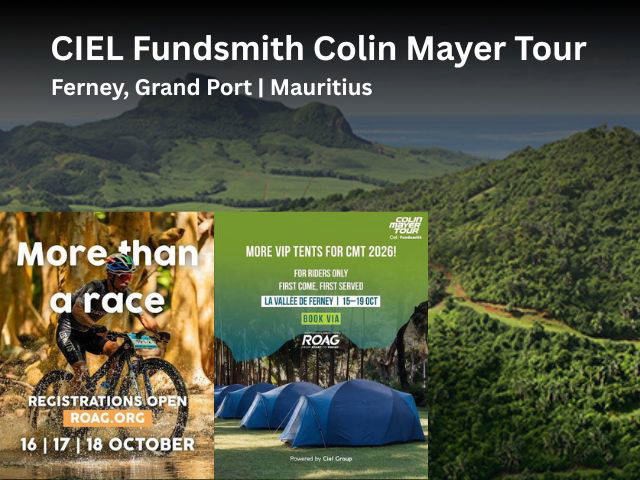
For nearly a decade, the CIEL Fundsmith Colin Mayer Tour has been a staple on the Indian Ocean racing calendar, defined by the sun-baked trails, salt pans, and coastal stretches of Cascavelle. It was built on the legacy of Colin Mayer, a Mauritian sports icon whose late but dominant entry into cycling left an indelible mark on the local peloton. When his family and friends launched the event in 2016, they created more than just a race; they built an incredibly tight-knit, two-rider team experience that tests your limits while delivering a legendary race village atmosphere. But for the October 16 to 18, 2026 edition, the Race Organisers Admin Group (ROAG) is shaking up the formula and taking the peloton somewhere completely new.
The tour is moving east to the lush, untamed landscapes of Ferney in Grand Port. This isn’t just a change of scenery, it’s a fundamental shift in the race's DNA. Riders who have spent years dialling in their lines on the drier, sandy tracks of the West Coast are going to find themselves completely out of their comfort zones. Ferney, home to the sprawling La Vallée de Ferney nature reserve, trades beach crossings for dense indigenous canopies and punchy, rugged valley climbs. You can expect a much more humid, loamy, and root-heavy technical challenge that will demand entirely different pacing and bike handling skills.
Perhaps the most exciting part of this relocation is how it completely levels the playing field. Returning veterans will have no home-court advantage, meaning the 2026 race will be a true test of adaptability and on-the-fly teamwork over three demanding stages. Over the years, the tour has built a reputation for attracting top-tier talent from Mauritius, Réunion, South Africa, and Europe. Well-known riders who have repeatedly tackled the race include Mauritian standout Alexandre Mayer (who won the 2018 title alongside South African Reinhard Zellhuber and took second in 2023 with Keagan Bontekoning), as well as the formidable 2023 champions, South African duo Tristan Nortje and Franko van Zyl. Local podium threats like William Piat and Torea Célestin have also historically left their mark. While the official start list for the 2026 edition has not yet been announced, the new East Coast route is expected to draw a similar calibre of international and regional athletes eager for a fresh challenge.
Interestingly, for a race that draws such high-level competitors, the prize purse is entirely non-existent. In keeping with the founders' ethos, the Colin Mayer Tour operates strictly as a non-profit event with absolutely no cash prizes or category winners. Riders line up purely for the love of the sport, personal achievement, and the renowned hospitality. That hospitality, including full catering and C Care medical support, remains a cornerstone of the event, but the basecamp will feel vastly more embedded in deep tropical forest rather than a bustling coastal resort.
While the classic two-rider team format remains the premier category to chase, the organizers have also drawn a hard line on e-bikes this year. E-bikes are welcome, but only in a non-competitive solo category. They will be rigorously tested each morning to ensure they are governed at a maximum of 30 km/h, and there is a strict zero-tolerance policy for towing. Any analogue rider caught taking a pull from an e-bike will face immediate disqualification, preserving the pure competitive spirit of the race.
With a completely redesigned route and a levelling of the competitive landscape, the East Coast edition of the Colin Mayer Tour is shaping up to be one of the most unpredictable and exciting stage races of the year.
End-Note: The SA Rider's Travel & Budget Guide
For a South African rider flying out of Johannesburg, a complete trip to the Colin Mayer Tour in Mauritius can run anywhere from R13,500 on a strict budget up to R30,000+ for a premium "race-cation" experience.
Here is the exact breakdown of what you can expect to pay for the 2026 edition (based on an exchange rate of roughly 1 MUR to 0.34 ZAR):
1. Flights (Johannesburg to Mauritius)
- Air Mauritius: Standard direct round-trip economy flights in October typically sit around R8,900.
- Budget Airlines: Carriers like FlySafair can sometimes offer promo fares closer to R5,500 - R6,000 return.
2. Bike Transport
Bringing your own bike is often the hidden cost that catches riders off guard:
- Air Mauritius: They now charge for sports equipment. On short- and medium-haul flights, such as between Johannesburg and Mauritius, sports equipment costs €75 (R1,520) per piece each way. This adds roughly R3,040 to your round-trip flight cost.
- FlySafair: Their sports equipment fee is much friendlier, charged at R285 per item per person per flight. This totals R570 for the round trip.
3. The Race Entry
The entry fee for the premier 3-day Full Stage Team format is 8,000 MUR (approx. R2,750) per person.
- The Bonus: This is an incredibly high-value entry because it includes almost all of your food. The fee covers your breakfast, lunch, and dinner at the race village on Friday and Saturday, plus breakfast and lunch on Sunday.
4. Accommodation
The new East Coast location at La Vallée de Ferney gives you two very different ways to stay:
- The Race Village Tents (Budget): You can book a standard single tent (mattress only) for 1,000 MUR (R340 for the whole event), or split a double VIP tent (with pallet beds and side tables) for 5,000 MUR (R850 per person).
- Ferney Nature Lodge (Premium): If you are leaning into the "race-cation" angle, booking the luxury eco-lodge right at the race basecamp, or heading to nearby coastal resorts, will add anywhere from R10,000 to R15,000+ to your trip, depending on how many extra days you stay to recover.