
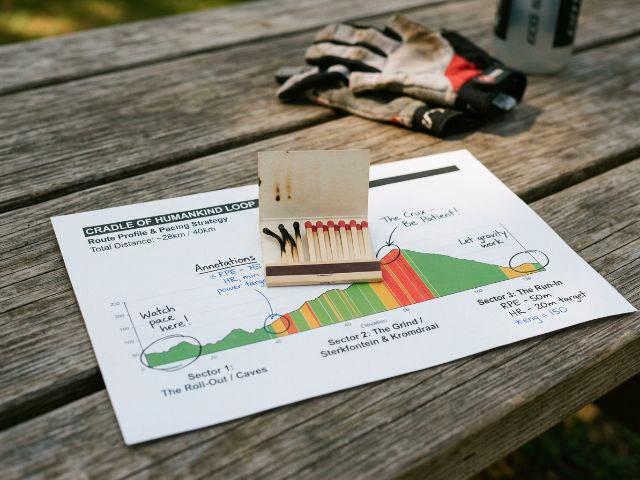
The Anatomy of a Route Card: Where Races Are Actually Won and Lost
By James Baxendale on 16 October 2026
Before you look at the distance, you look at the elevation chart. It’s an involuntary reflex for endurance athletes. A jagged, toothy profile immediately tells you whether you’re in for a fast, tactical morning or a brutal war of attrition. But a great route isn't just about the scenery or total elevation gain, it’s about rhythm. The best courses have a narrative built in by the race director: a warm-up, a false sense of security, a crux, and a fast or challenging finish.
Course designers know exactly what they are doing when they map out a race, utilizing the terrain to force decisions and build a memorable blueprint. Take the psychological trap of the false flat, for instance. A subtle gradient looks completely flat to the naked eye but inexplicably saps your legs and drags your heart rate into the red. Then there are choke points, where sudden transitions from wide gravel roads into technical single-track force a surge in pacing. If you aren't positioned well beforehand, you get caught in traffic. Designers also love a sting in the tail, placing a steep, punchy kicker in the last stretch of a route to force athletes to decide whether to hold back in the middle miles just to survive the finale.
To see how this plays out in the real world, let's deconstruct a classic local route as an example: the standard Cradle of Humankind Loop. Whether you are running it as a marathon build-up or riding the circuit, it’s a masterclass in rhythm that perfectly punishes poor pacing.
The early undulating miles heading out past the caves act as a trap. They are fast, your legs are fresh, the morning air is cool, and the slight descents make you feel invincible. This is where the route lies to you. Going out ten seconds per kilometre too fast or pushing twenty watts over your target here will completely ruin your second half.
As you hit the drags past Sterkfontein and Kromdraai, the course shows its teeth. This is the crux of the loop, a classic grind that isn't steep enough to force you out of the saddle, but long enough to slowly drain your reserves. The best strategy here is patience. Dialling back your effort by just five percent on these drags allows you to crest the climbs with enough physiological capital to actually race the final stretch.
That final descent back toward the start is where the route rewards the disciplined. For cyclists, it’s about getting aero and using free speed. For runners, long descents mean massive eccentric loading on the quads. If you burned your matches on the early climbs, your legs will feel like lead here. If you paced it right, you can let gravity do the work and carry massive momentum to the finish.
Once you understand this anatomy, you have to throw away the concept of average pace to truly master your strategy. Trying to hold a steady minute-per-kilometre or a flat average speed on an undulating route is a recipe for a blowout. Instead, map your effort to the terrain, breaking the route down by Rate of Perceived Exertion or power targets. Think of your energy as a book of matches. You only get so many to burn during a race. You need to look at the route card and decide exactly where you are willing to strike a match to get up a steep kicker or pass a group, and strictly define the sections where you must recover. Pacing a route isn't about running or riding a flat line, it’s about surfing the elevation.
What’s your favourite local route segment that always demands a specific pacing strategy? Hit reply and let us know. Next week, we'll dive into the world of alternative endurance fuels and why sustainable proteins might be the missing link in your mid-race nutrition.