
Calculating your personal sweat rate and Nailing Your Hydration in the Highveld vs. The Coast
By James Baxendale on 24 October 2026
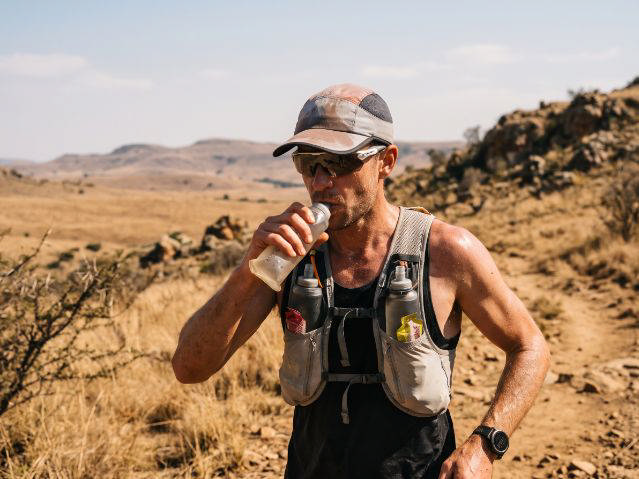
Whether you are logging early morning kilometres on the dry trails of the Highveld or toeing the start line at a humid coastal ultra, your body’s cooling system is working in overdrive. But how it cools you changes drastically depending on the environment. Up at altitude in dry heat, sweat evaporates incredibly efficiently. Your cooling system works perfectly, but because the sweat vanishes so quickly, you might not feel like you are losing much fluid, leading to dangerous under-drinking. Coastal environments are a different beast. In high humidity, the air is already saturated with moisture. Sweat cannot evaporate, so it simply drips off your skin, providing zero cooling effect. As your core temperature climbs, your body panics and pumps out even more sweat, which can increase your sweat rate by 20% to 30%.
Understanding your personal sweat rate is the only way to build a reliable hydration strategy. The testing process is straightforward: empty your bladder, weigh yourself naked, and run for 60 to 90 minutes at race pace. Keep track of exactly how much fluid you drink in litres. Afterward, towel off completely and weigh yourself again. Subtract your post-weight from your pre-weight, add the fluid you consumed, and divide that total by the hours you ran.
Studies show that sweat rates are highly individual, typically ranging from 0.5 to 2.5 litres per hour, and replacing 100% of that fluid is virtually impossible and often dangerous.
The Low-to-Moderate Sweater (60kg Athlete) If a 60kg athlete runs for 90 minutes, loses 1.2kg of body weight, and consumes 0.3 litres of fluid, their sweat rate is 1.0 litre per hour. Because it is difficult for the gut to absorb fluid as fast as it is lost, this athlete should aim to replace 50% to 80% of their sweat loss during the session, targeting roughly 600ml to 800ml per hour in small, frequent sips.
The High Sweater in Humidity (75kg Athlete) If a 75kg athlete runs for 60 minutes in humid coastal conditions, loses 1.5kg, and drinks 0.4 litres of fluid, their sweat rate spikes to 1.9 litres per hour. A rate this high exceeds what the gut can comfortably absorb. Instead of trying to force down 1.9 litres and causing stomach sloshing, the strategy shifts to damage control. They must hydrate at their maximum gut tolerance, typically 800ml to 1,000ml per hour, using fluids heavily loaded with sodium to speed up absorption.
The Low Sweater in Cool Conditions (90kg Athlete) If a 90kg athlete runs for 90 minutes, loses 0.6kg, and drinks nothing, their sweat rate is a mere 0.4 litres per hour. For low sweat rates, drinking to thirst is generally sufficient. Forcing down large volumes of water will easily dilute their blood sodium, making pre- and post-hydration much more critical than on-the-run fluid intake.
Maintaining mineral balance during these massive efforts requires replacing exactly what is lost, primarily sodium, followed by potassium, magnesium, and calcium. Relying on plain water alone dilutes blood sodium, making targeted sports nutrition essential.
Beneficial Sports Drinks The most effective sports drinks are hypotonic or isotonic, allowing water to cross the gut lining rapidly. Hydration mixes from brands like Näak, Skratch Labs, and Tailwind provide balanced electrolyte profiles paired with easily digestible carbohydrates. For heavy sweaters battling humid conditions, customizable powdered mixes from Precision Hydration allow athletes to dial in exactly 500mg, 1000mg, or 1500mg of sodium per litre based on their specific sweat rate data.
Energy Gels and Electrolytes It is important to remember that energy gels are engineered primarily as carbohydrate delivery vehicles, not dedicated hydration tools. While standard gels contain a baseline of sodium (usually 20mg to 60mg), this is vastly insufficient to replace the hundreds of milligrams lost per hour. Endurance-specific variations bump sodium up to 100mg to 200mg per packet, but they must almost always be paired with supplementary liquid electrolytes or salt supplements to fully stabilize your mineral balance over long distances.
The Extended Mineral Toolkit Endurance athletes often utilize a wider array of products to separate their hydration from their fuelling, which helps avoid gut rot and flavour fatigue. Salt capsules and unflavoured electrolyte drops allow athletes to swallow concentrated doses of sodium and magnesium with plain water, bypassing sweet drinks entirely. You can easily pick these up from local pharmacies like Dis-Chem and Clicks, or specialized running stores like Run Specialist Store. Out on the trail, aid stations rely heavily on salted boiled potatoes, pickles, and pretzels to provide highly bioavailable, real-food sodium that settles the stomach. Finally, post-run mineral balance is often restored using sustainable, whole-food protein sources, such as Matomani functional bars and protein powders, which naturally deliver massive concentrations of iron, potassium, and magnesium to help you rebuild for the next session.