Budget Racing: Navigating the Rising Costs of Race Entries and Local Travel
By James Baxendale on 09 April 2026
For many of us, the alarm clock at 4:30 AM isn’t just a wake-up call; it’s the start of a ritual. Whether you’re a weekend warrior on the trails or a marathon veteran, the passion for racing is undeniable. However, as we move through 2026, the "lifestyle" of racing has become a significant line item in our household budgets. From the "hidden" admin fees to the soaring cost of a coastal weekend, navigating the financial side of sports is now as much of a challenge as the race itself.
The Entry Fee Landscape: From Local Loops to "Bucket List" Events
Entry fees have seen a steady climb, largely driven by increased security, medical requirements, and logistical overheads.
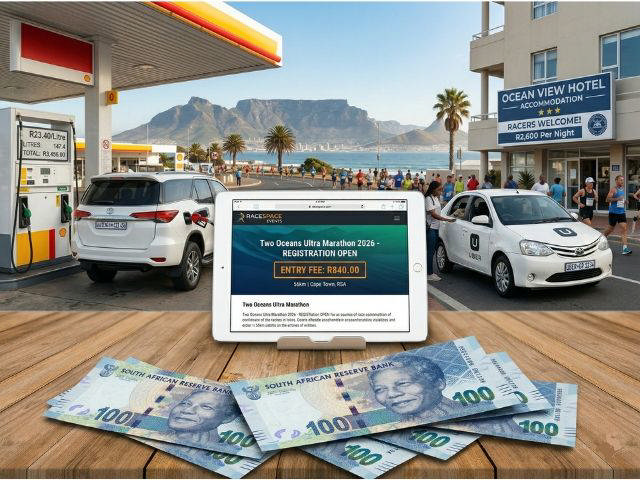
In Road Running, a local 10km in Gauteng (like the Johannesburg City Marathon series) currently sits at approximately R190, while a Half-Marathon (21.1km) averages R290. When you shift to "sanctioned" national majors, the price jumps: the 2026 Two Oceans Ultra (56km) entry is R840, and the Comrades Marathon is now R1,200 for South African citizens.
MTB and Triathlon often carry a higher premium due to the technical nature of the events. A local Nissan Trailseeker event offers great value at R319 for the 70km Marathon, but high-profile events like 947 Ride Joburg (MTB) are closer to R810. For those eyeing the Ironman 70.3 circuit, entry fees for 2026 range from R3,800 to R7,000, depending on how early you commit.
The True Cost of Getting There
The entry fee is often just the "cover charge." For an inland athlete traveling to a coastal event like the Two Oceans or Ironman Mossel Bay, the travel logistics are often the heaviest burden.
- Fuel & Tolls: With the April 2026 petrol price hike hitting ~R23.40/litre (95 Inland), a return trip from Johannesburg to Durban (~1,200km) can cost upwards of R3,000 in fuel alone for a standard SUV. Adding N3 toll fees (approximately R350 one way for a light vehicle) brings your "commute" to nearly R4,000 before you've bought a single energy gel.
- Local Commuting: Once at your destination, an Uber for short trips (e.g., from your stay to the race start) averages R65 – R85 in major metros, though surge pricing on race mornings can easily double this.
Accommodation: The "Event Weekend" Premium
Traveling between provinces usually necessitates a minimum two-night stay. In Cape Town, the 2026 average for a mid-range Airbnb is roughly R2,600 per night. During major race weekends, these rates often spike by 20–30% due to demand. In more rural race towns, while "value" spots exist around R1,200/night, availability is the primary hurdle, often requiring bookings six to twelve months in advance.
The Paperwork: Licenses and Memberships
Finally, don't forget the "legal" side of racing. To avoid the Temporary License fees, which range from R60 (10km) to R200 (Marathon), most frequent racers opt for permanent club licenses.
- Running: An ASA/CGA Senior Permanent License for 2026 is approximately R180 to R230 (excluding club membership fees, which average R500 to R600).
- Cycling: CSA (Cycling South Africa) memberships are essential for sanctioned events, often bundled with club fees. A typical club membership like Northcliff Cycles is roughly R600, which covers your affiliation and administrative support.
The Bottom Line
Racing on a budget in 2026 requires a strategic approach. By prioritizing local sanctioned events and carpooling for inter-city travel, you can keep the passion alive without breaking the bank. While the coastal "destination" races remain the pinnacle of the season, the heart of South African racing still beats in the affordable local club events that keep us moving every Sunday morning.